I'm a vocal coach. And over the years, I've come across a lot of people who WISH they could sing well… but they think they are "tone deaf". In other words, they think they have a genetic barrier, which causes them to be totally off pitch. And thus any dream they have of ever singing well, will only ever be crushed by the oppresive weight of bitter reality:
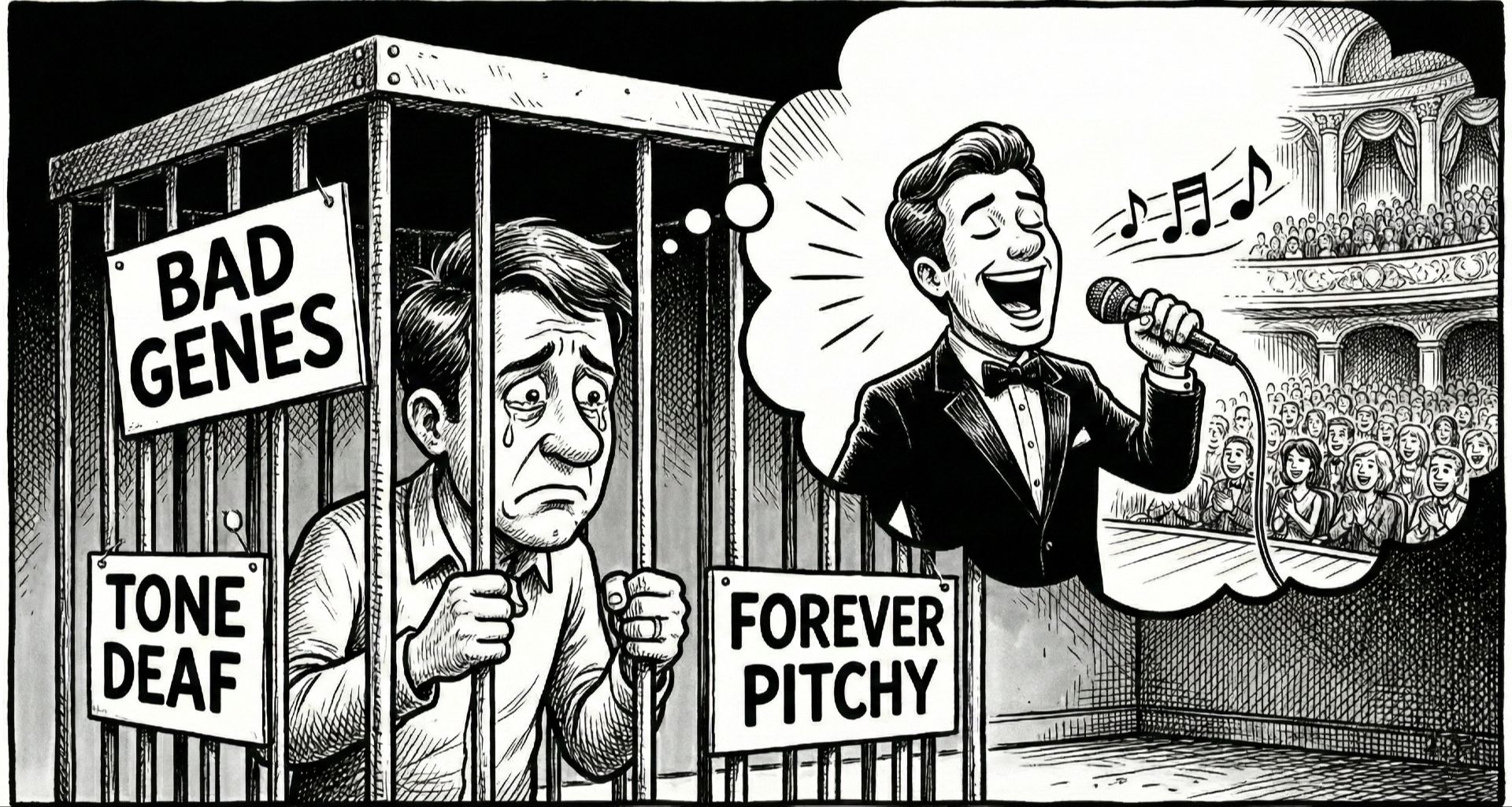
So sad. Maybe you're one of those people. And if so, you probably stop yourself from singing in front of others: at parties, at karaoke, maybe even around your own family members. And that sucks.
But what if this belief is based on a simple misunderstanding? What if you could prove to yourself, in the next two minutes, that the label you've carried for years... is flat out wrong?
Let's find out. We're going to test the two main components of what people call "tone-deafness": your pitch perception (your "ear") and your pitch production (your "voice").
Test #1: The Pitch Perception Test (Are Your Ears Working?)
This first test will determine if you have a problem with basic pitch perception.
Watch this video and follow the instructions:
As the video says…
… If you can consistently and correctly tell whether the second note was higher or lower than the first, then congratulations. Your pitch perception is not the problem. You do not have the primary symptom of clinical amusia (true tone-deafness). Your "ears" are working.
For the vast majority of people—likely over 98% of you reading this—this will be the case. You might have to listen closely, and think about it, but you can tell the difference between notes. This is a crucial piece of data. It proves that the problem is not in your ability to hear the right notes. And so you are not actually tone deaf.
So, if your ears are working, why can't you sing in tune?
Test #2: The Pitch Production Test (Is Your Voice Working?)
This is where things get interesting. This second test measures the connection between your ear and your voice.
Instructions:
- Open a voice recording app on your phone
- Start recording
- Go to this browser-based virtual piano (you can do it on the phone that is recording... or a different device): https://www.onlinepianist.com/virtual-piano
- While your phone is recording…play a single note on the piano
- Try to sing that note on a simple, open vowel, like "Lah"
- Try this with various notes - hit the piano key, and try to sing that note
- Stop the recording
- Listen back to the recording. Does your "Lah" match the piano note?
Interpreting Your Results
For many of you who believe you're tone-deaf, this is where the failure happens. The note you sang will be flat (too low), sharp (too high), or just wobbly and uncertain. The recording will be the "proof" that confirms your fear: you can't currently sing in tune. (Oh no!!)
But you are drawing the wrong conclusion from the data!
This test does NOT prove you are tone-deaf. It proves that your vocal cords are not yet trained to obey the instructions from your brain.
To better understand this point… think of a perfect circle. See it in your mind, perfectly curved, perfectly even. Picture that for a moment.
Now… if you were to get a piece of paper, and a pencil, and try to draw that perfect circle… you would almost certainly see imperfections in the circle you drew (feel free to try it, to illustrate the point). The lines would curve more sharply in some areas than others; it might be wavy in parts; the circle might look a bit more like an oval.
Here's what's happening: your brain knows what a perfect circle looks like… but your hand is not yet coordinated enough to draw it. The problem is not your brain; it's your hand's lack of training. Something that can be improved with practice.
The same is true of your pitch problems too.
The Real Diagnosis: You Have "Vocal-Motor-Control-Deficiency-Due-to-Lack-of-Training"
It's not as catchy as "tone-deaf," is it? But it's far more accurate. You don't have a disease. You have a skill deficit.
Why is your vocal motor control so poor? Simply put, it's because you're using the wrong muscles, in the wrong way. Because you've never been trained to use the right muscles in the right way - using techniques like the ones I teach in this singing course for beginners.
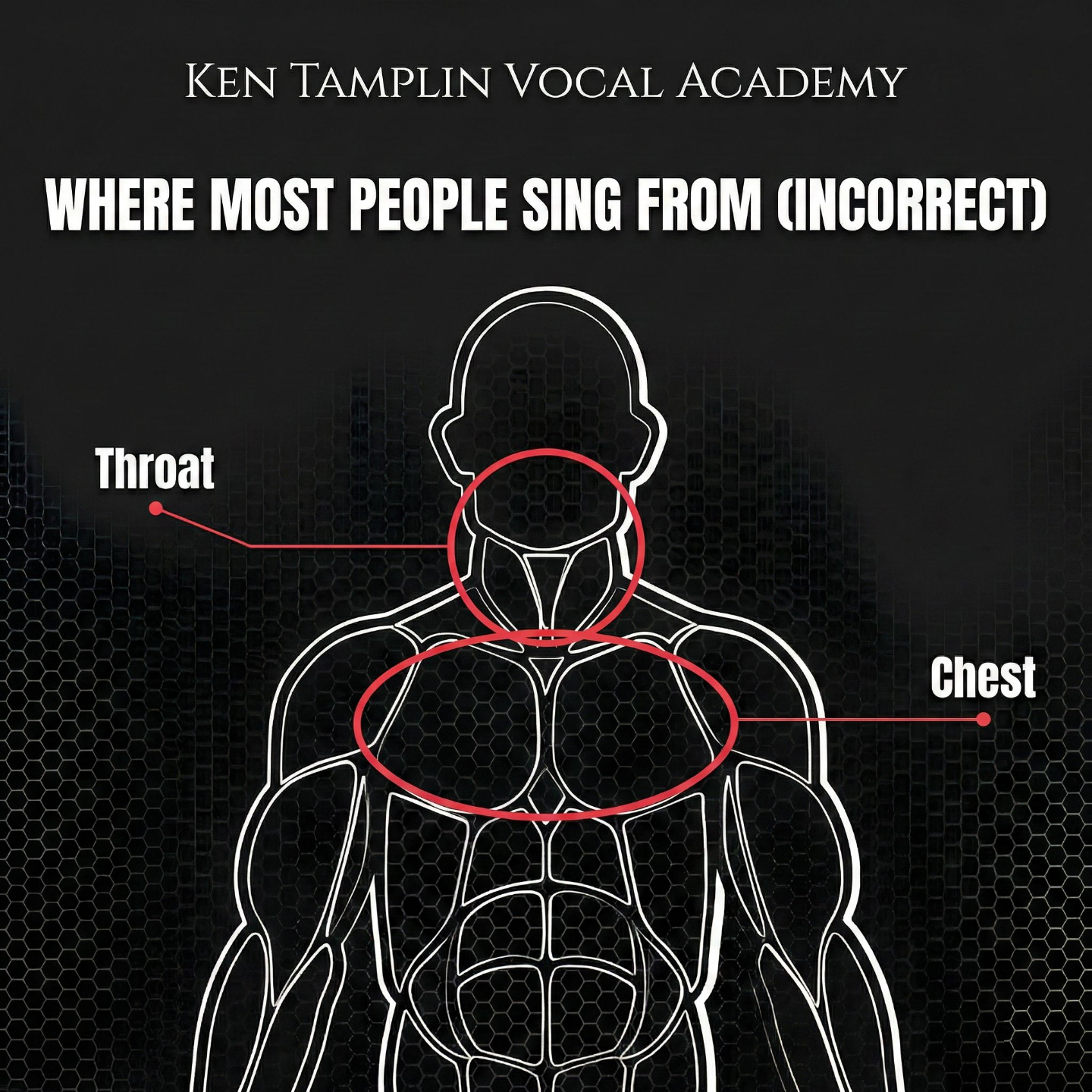
For example… most people try to sing "from" their throat and their chest. That is where they draw breath from… and push air from when they sing:
But this is actually incorrect. The goal is to have your diaphragm do all the work—and believe it or not you learn to relax the chest, the neck, and the throat:
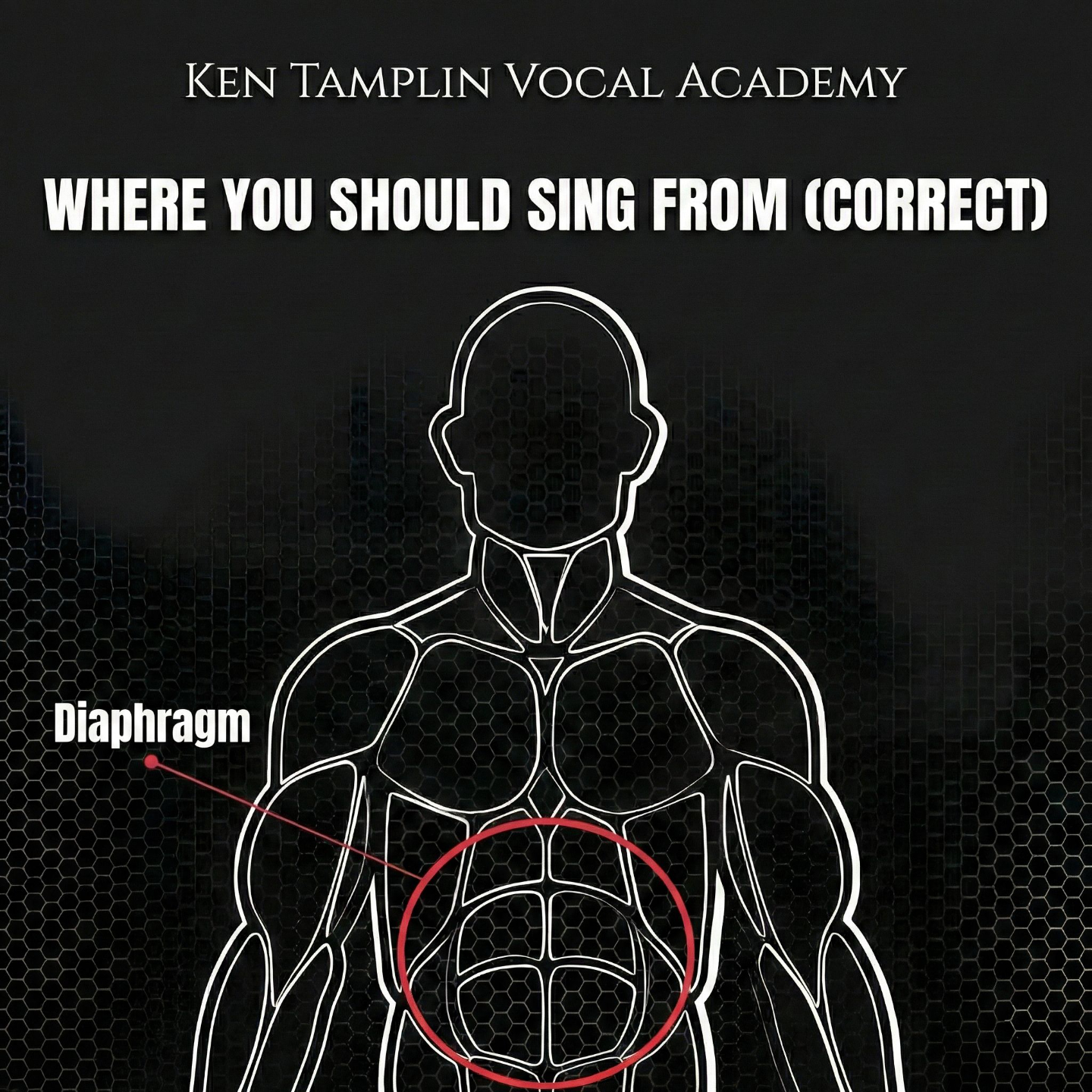
Think of singing like shaping clay on a potter's wheel. Your diaphragm is the wheel, providing the consistent energy and movement. Your throat is like the potter's hands, delicately shaping the spinning clay into a precise form. If you tried to hold, spin, and shape the clay with JUST your hands… you'd get a mess. You need the wheel to provide the power, so the hands can do the finer, artistic work of shaping the clay.

It's the same with singing: when you learn to get your power from your diaphragm, like I teach in lesson 7 of 30 Minute Singer, the throat becomes relaxed. Which frees it to act like a fine-tuning instrument, making the small, precise adjustments needed to match the pitch you hear in your head.
And that's only one of many ways to improve your pitch (and range, and power, and tone) through basic training.
The Final Verdict
So, what did our two tests reveal?
- Test #1 showed that your ears are working. You can perceive pitch.
- Test #2 showed that your voice is not yet trained to reproduce that pitch accurately.
This is the best news you could possibly get. Why? Because while a genetic disorder cannot be fixed… a skill deficit absolutely can.
You are not tone-deaf. You are untrained.
So excuse me getting a little preachy… but stop letting a false diagnosis define your life. You've just proven to yourself that the label is wrong. If you've always wanted to sing well, you now know genetics won't get in the way. So, what are you going to do about it?
Do you want to sing well?
What would that unlock for you, if you could?
How we can help
At KTVA, we specialize in fixing "Vocal-Motor-Control-Deficiency-Due-to-Lack-of-Training" (note to self: come up with a catchier name).
We've simply watched too many people go from "super pitchy" to "sounds really nice" to believe that anyone is a lost cause.
We know that with the right, targeted exercises, anyone can train the connection between their ear and their voice. Our 30-Minute Singer program is a step-by-step guide to doing just that. It's a workout program for your voice, designed to easily fit in your schedule… that builds the muscle and coordination you need to finally sing the notes you hear in your head.
If you passed Test #1 but failed Test #2, this program was (quite literally) designed for you. It's the bridge between your voice now, and your voice as you've always wished it could be.
Learn more about 30-Minute Singer